
How purpose-designed ligands change viral vector purification
Advanced biologics are placing increasing demands on affinity chromatography.
Many purification workflows rely on biologically-derived ligands. Their selectivity, binding geometry, release behavior, and chemical stability help define process conditions across molecules that can behave very differently.
What if modern DSP technologies were designed to overcome these challenges?
Purpose-designed synthetic peptide ligands create a different starting point. Ligand sequence, target binding site, density, linker chemistry, and matrix architecture can be selected and optimized together around the product and the separation required. This gives downstream developers more control over how the complete affinity system recognizes, retains, releases, and protects the product.
For viral vectors, this creates more control over the variables affecting capsid or pseudotype coverage, functional recovery, elution, impurity clearance, cleaning, and reuse.
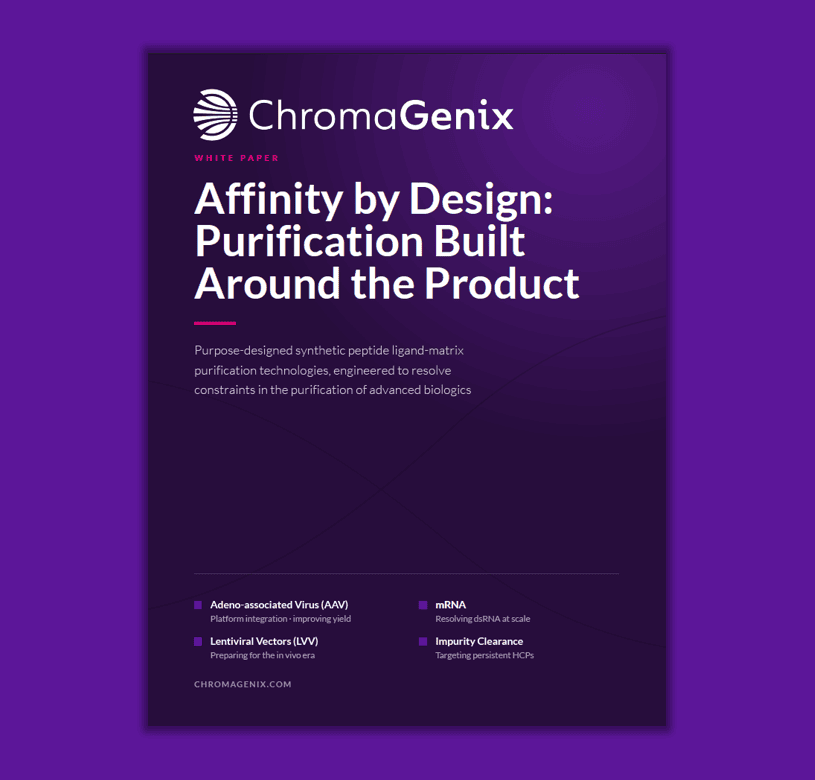
Affinity by Design: Purification Built Around the Product explores how ChromaGenix combines tunable synthetic peptide ligands and ligand-matrix design across AAV, LVV, mRNA, and recombinant proteins, with AvXcel™ as the lead AAV capture example.
What you’ll learn
· How conserved, surface-accessible capsid regions inform ligand design for broad AAV recognition
· How model-supported multisite binding can balance capture with mild release
· What AvXcel evidence shows across AAV1–9 and rh10
· What optimized AAV2, AAV5, AAV6, and AAV9 studies report for capsid yield and host-cell impurity reduction
· How purpose-designed impurity-binding systems can protect downstream AAV capture
· How synthetic ligand and support design influence functional recovery in LVV purification
· How the same design framework is applied to mRNA impurity discrimination and recombinant-protein HCP removal
The document distinguishes peer-reviewed findings, official product information, and ChromaGenix data on file, so readers can see what is established, what is product-specific, and what still requires process-specific evaluation. Submit your information below to access the White Paper.
Copyright @ 2026. All rights reserved.